Introduction
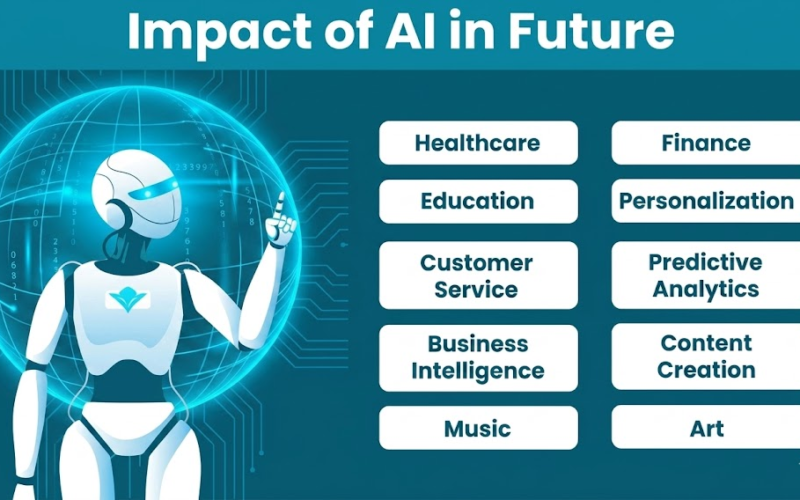
Artificial Intelligence is advancing at an unprecedented pace. From writing articles and generating images to diagnosing diseases and powering self-driving cars, AI is transforming industries across the globe. As these technologies become more sophisticated, one question continues to spark debate among researchers, businesses, and everyday users:
AI vs Human Intelligence: Who Wins in Creativity, Learning, and Decision-Making?
The discussion of AI vs Human Intelligence is no longer limited to science fiction. It is now a real-world topic affecting education, healthcare, employment, and innovation. While AI can process vast amounts of information within seconds, human intelligence offers unique abilities such as creativity, emotional understanding, and ethical reasoning.
This article explores the strengths and weaknesses of AI vs Human Intelligence, focusing on three critical areas: creativity, learning, and decision-making. By understanding how each performs, we can better predict the future relationship between humans and intelligent machines.
Understanding AI and Human Intelligence
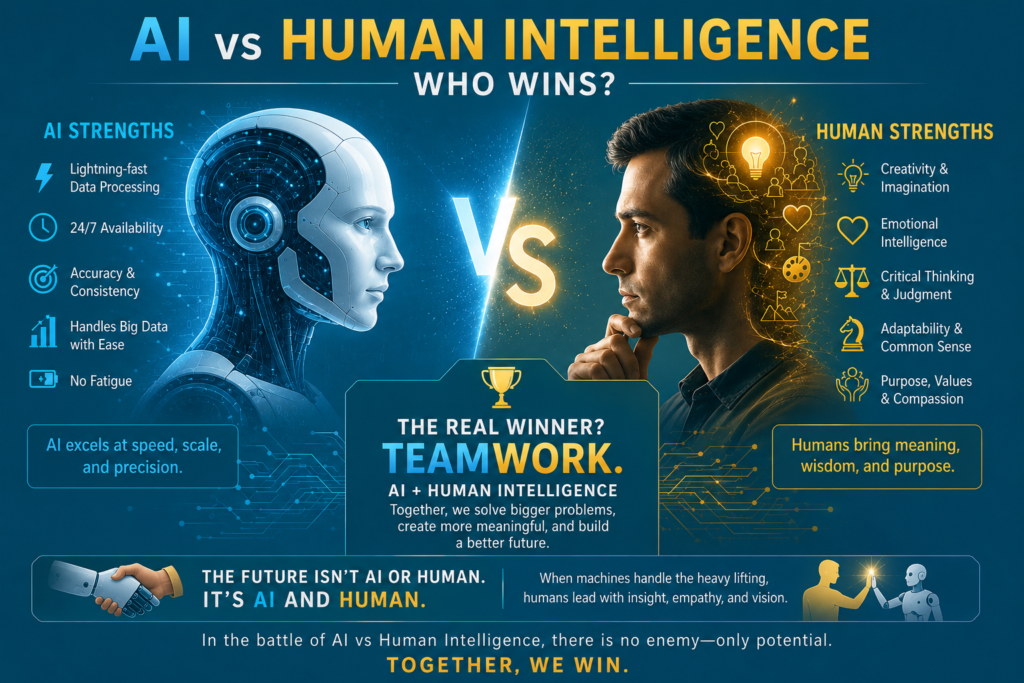
Before diving deeper into AI vs Human Intelligence, it is important to understand what each term means.The tasks of Artificial Intelligence include pattern recognition, language processing, data analysis, and problem-solving.
Human intelligence, on the other hand, is the natural ability of people to think, reason, learn, create, communicate, and adapt. Human intelligence is shaped by experiences, emotions, culture, and social interactions.
The comparison of AI vs Human Intelligence becomes fascinating because both can solve problems, yet they approach them in completely different ways.
AI vs Human Intelligence in Creativity
Creativity is often considered one of humanity’s greatest strengths. It allows people to invent technologies, write stories, compose music, and solve complex challenges in unique ways.
- How AI Creates ?
Modern AI tools can generate text, artwork, videos, music, and designs. By analyzing enormous datasets, AI identifies patterns and produces content that resembles human-created work.In the debate of AI vs Human Intelligence, AI demonstrates impressive creative abilities. It can produce thousands of design concepts in minutes and generate content faster than any human.
However, AI does not create from personal experiences or emotions. Its outputs are based on data and learned patterns.
- How Humans Create ?
Human creativity comes from imagination, curiosity, emotions, and life experiences. Artists, scientists, and innovators often develop ideas that have never existed before.
When comparing AI vs Human Intelligence, humans maintain a significant advantage because they can think beyond existing patterns. Breakthrough inventions and revolutionary ideas often emerge from intuition and unconventional thinking.
Creativity Winner
In the category of creativity, AI vs Human Intelligence has a clear winner: human intelligence. AI can assist creativity, but humans remain the true source of original innovation.
AI vs Human Intelligence in Learning
Here is a clear comparison table: AI vs Human Intelligence in Learning
| Feature | AI Learning | Human Intelligence Learning |
| Learning Method | Uses machine learning algorithms and data training | Learns through experience, observation, and education |
| Speed of Learning | Extremely fast with large datasets | Slower but deeper understanding over time |
| Data Requirement | Needs huge amount of structured data | Can learn from small samples and real-life experience |
| Adaptability | Limited outside trained data | Highly adaptable to new and unknown situations |
| Memory | Stores and retrieves data perfectly | Memory can fade or become biased over time |
| Understanding Context | Limited contextual understanding | Strong contextual and situational understanding |
| Creativity in Learning | Generates patterns based on existing data | Creates new ideas and concepts independently |
| Error Handling | Improves through retraining and updates | Learns from mistakes and personal reflection |
| Emotional Influence | No emotions involved | Emotions strongly influence learning process |
| Flexibility | Task-specific learning | Can transfer knowledge across different fields |
AI vs Human Intelligence in Decision-Making
Decision-making affects every aspect of life, from business strategies to medical treatments.
AI Decision-Making
AI relies on algorithms and data analysis. It evaluates information objectively and identifies patterns that humans might overlook.Businesses increasingly use AI to make predictions, optimize operations, and improve efficiency.
One strength in AI vs Human Intelligence is AI’s ability to analyze massive datasets without fatigue or emotional bias.
Human Decision-Making
Humans combine logic with emotions, ethics, intuition, and experience. This allows them to make decisions in complex situations where data alone is insufficient.
For example, a doctor may consider a patient’s emotional state in addition to medical data.
Ethical Judgment
A crucial factor in AI vs Human Intelligence is ethics. Humans understand moral responsibility and social consequences. AI systems simply follow programmed objectives.
Decision-Making Winner
For data-driven decisions, AI often performs better. For ethical and complex human-centered decisions, humans remain superior.
Emotional Intelligence: A Human Advantage
Emotional intelligence is the ability to understand and manage emotions.
In the comparison of AI vs Human Intelligence, this remains one of humanity’s strongest advantages.
Humans can:
- Show empathy
- Build relationships
- Understand emotional context
- Resolve conflicts
- Inspire others
Although AI can recognize emotional patterns, it does not genuinely experience feelings.
This distinction significantly impacts leadership, counseling, healthcare, and education.
1. Speed and Accuracy
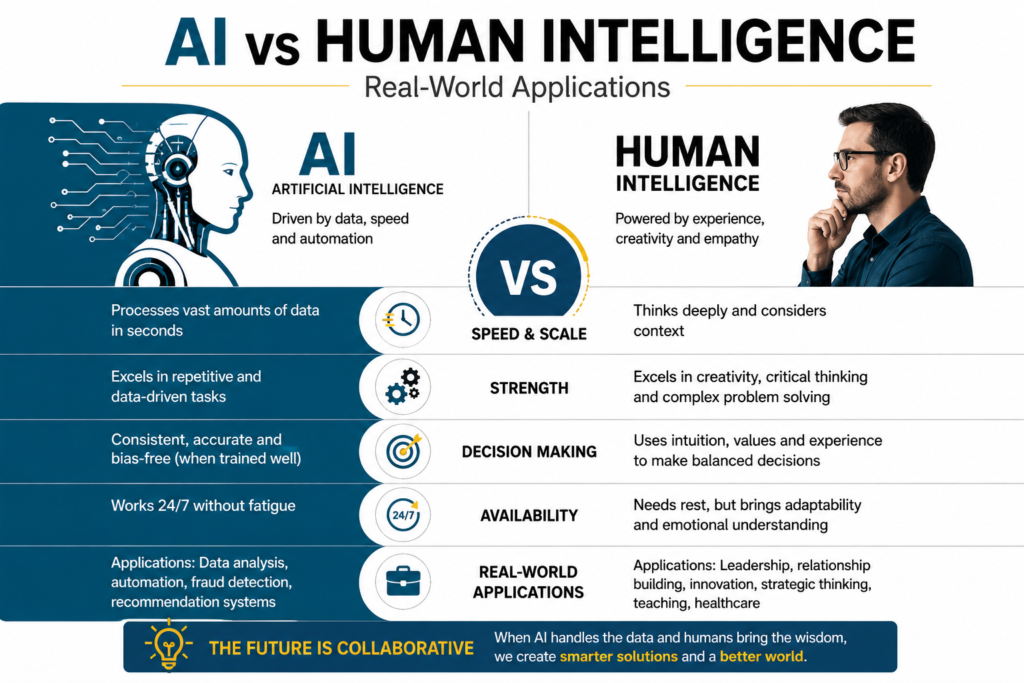
One area where AI vs Human Intelligence clearly favors AI is speed.
AI systems can:
- Process millions of records instantly
- Analyze data continuously
- Perform calculations without errors
- Work 24/7 without fatigue
Humans simply cannot match this level of computational efficiency.
However, speed alone does not guarantee wisdom or understanding.
2. Problem-Solving Capabilities
Problem-solving is another important aspect of AI vs Human Intelligence.
AI excels at solving structured problems with clear rules and objectives. Examples include chess, logistics optimization, and financial forecasting.
Humans excel at solving unstructured problems involving uncertainty, emotions, and changing conditions.
This difference demonstrates that AI vs Human Intelligence should not always be viewed as a competition. Often, the best results occur when both work together.
3. Real-World Applications
The impact of AI vs Human Intelligence can be seen across various industries.
- Healthcare
AI helps doctors analyze medical images and detect diseases. Human physicians provide empathy, communication, and ethical judgment.
- Education
AI offers personalized learning experiences, while teachers inspire students and address emotional needs.
- Business
AI improves efficiency and data analysis. Human leaders provide vision and strategic direction.
- Creative Industries
AI assists with content creation, but humans continue to drive original storytelling and innovation.
The Future of AI vs Human Intelligence
The future of AI vs Human Intelligence is likely to involve collaboration rather than competition.
Experts predict that AI will automate repetitive tasks while humans focus on creativity, leadership, and innovation.
Instead of replacing human intelligence, AI will serve as a powerful tool that enhances human capabilities.
As technology evolves, organizations that successfully combine human expertise with AI systems will gain significant advantages.
Frequently Asked Questions
Is AI more intelligent than humans?
AI is superior in specific tasks such as data analysis and pattern recognition. Human intelligence remains superior in creativity, emotional understanding, and ethical reasoning.
Can AI become creative?
AI can generate creative outputs, but it lacks genuine imagination and personal experiences.
Will AI replace human jobs?
Some routine jobs may be automated, but new opportunities requiring creativity, leadership, and critical thinking will continue to emerge.
What is the biggest difference between AI and human intelligence?
The biggest difference is consciousness. Humans possess self-awareness, emotions, and ethical understanding, while AI operates through algorithms and data.
Who wins in AI vs Human Intelligence?
The answer depends on the category. AI wins in speed and data processing, while humans win in creativity, emotional intelligence, and ethical decision-making.
Conclusion
The debate surrounding AI vs Human Intelligence is one of the most important technological discussions of our time. AI has demonstrated extraordinary capabilities in learning, data processing, and analytical decision-making. However, human intelligence continues to excel in creativity, emotional understanding, ethical reasoning, and adaptability.
When evaluating AI vs Human Intelligence, there is no single winner. AI dominates tasks that require speed, accuracy, and large-scale data analysis. Humans dominate areas that require imagination, empathy, and complex judgment.
The future is not about choosing between AI and humans. Instead, the greatest opportunities will emerge when human intelligence and artificial intelligence work together. By combining the strengths of both, society can unlock new levels of innovation, productivity, and progress that neither could achieve alone.